A Chemical Spill at 2 AM. Your HazMat Team Is 45 Minutes Away. Now What?
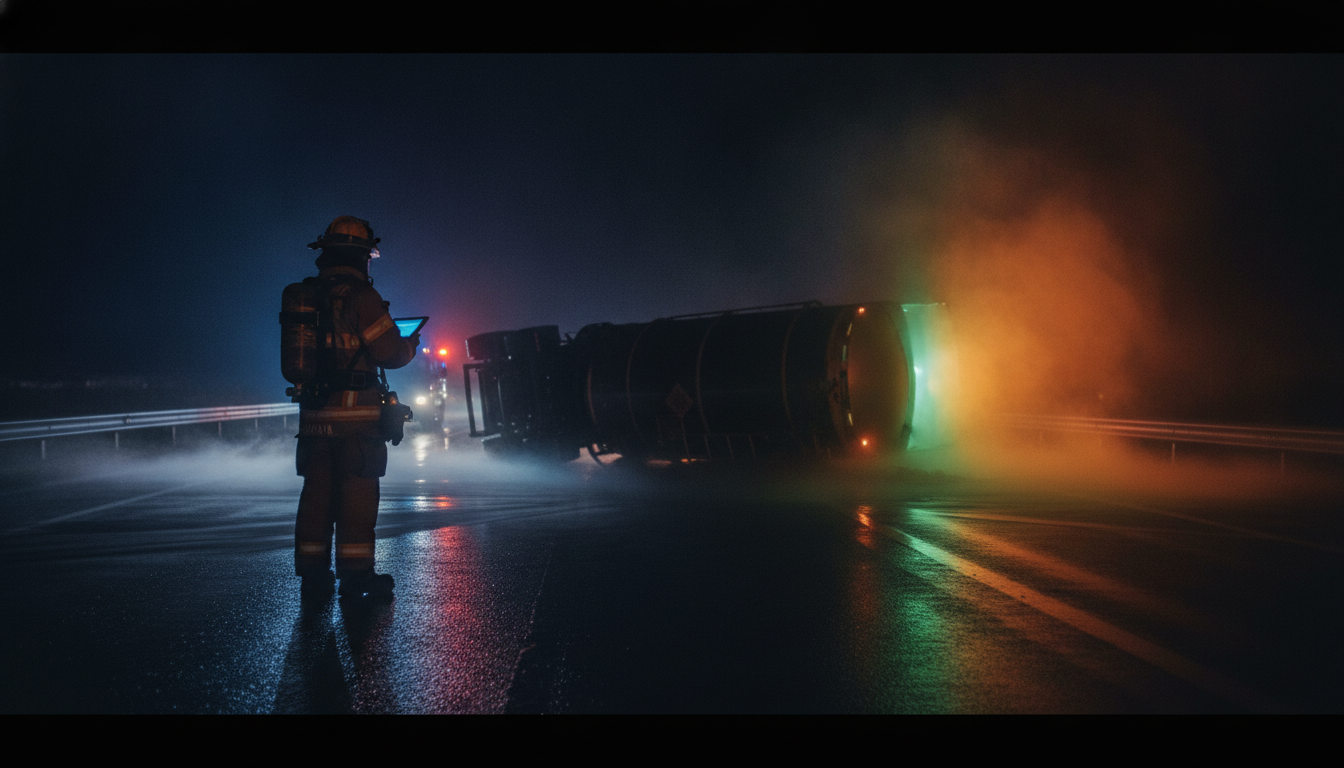
When a hazmat incident unfolds at 2 AM, the first 15 minutes determine outcomes. For the majority of small and mid-sized fire agencies without a dedicated hazmat team, those 15 minutes pass before any specialized help arrives. The question is not whether your people are trained. It is whether they have the right information at the right moment to make good decisions while they wait.
The Problem Nobody Talks About at the Chief's Conference
Over 2.5 million tons of hazardous materials move across North American highways, railways, and waterways every year. That tanker truck on the highway outside your community could be carrying anhydrous ammonia, chlorine gas, or any of thousands of regulated substances. When it tips, leaks, or catches fire, the first agency on scene is almost always yours.
Here is the uncomfortable truth: most small and mid-sized fire agencies do not have a dedicated hazmat team. They rely on mutual aid agreements with regional teams that may be 30, 45, or even 60 minutes away. Meanwhile, the wind is shifting, the product is pooling, and the residents on the downwind side have no idea what they are breathing.
Survey data from frontline responders makes this gap concrete. Seventy percent identified further training as their top need for hazmat response. Sixty-four percent cited additional funding. Forty-six percent said they need better access to detection and identification tools. These are not wish-list items. They are the distance between being on scene and being effective on scene.
What Happens in the First 15 Minutes
Hazmat response follows a predictable decision sequence, and those first 15 minutes are where outcomes are largely determined. The initial arriving officer needs to identify the product, establish isolation distances, determine protective action decisions for the surrounding population, and request the right level of mutual aid, all before a single specialized resource arrives on scene.
For agencies that encounter hazmat incidents one to four times per year, which is the majority according to survey data, this is a low-frequency, high-consequence scenario. The responders are not incompetent. They are experienced firefighters and officers who simply do not encounter these incidents often enough to stay fluent with the ERG, NIOSH pocket guides, SDS interpretation, and the cascade of isolation, notification, and protective action decisions that a chemical release demands.
The chemistry of what they are responding to varies enormously. Flammables account for 79% of encountered hazmat types. Airborne particulates make up 51%. Corrosives represent 42%. Each category requires different approach distances, different PPE levels, and different decontamination protocols. Confusing any of these in the field is not an academic error. It is a life safety failure.
Why Mutual Aid Is Necessary but Not Sufficient
The cooperative response model that small and mid-sized agencies depend on is structurally sound. Hazmat operations require specialized equipment that no small agency can justify purchasing and maintaining independently. Regional teams, shared caches, and mutual aid agreements are the right framework.
But the model has a gap, and that gap is the 30 to 60 minutes between initial arrival and the arrival of that specialized team. During that window, the incident commander is deciding between evacuation and shelter-in-place, establishing hot and warm zones based on incomplete product identification, and managing a scene that is actively evolving. Every one of those decisions happens under time pressure, with limited information, and with real consequences for the people downwind.
This is not a problem that a 40-hour hazmat technician course solves. It is an information access problem. The knowledge exists in the ERG, in NIOSH databases, in CAMEO and ALOHA modeling tools, and in the agency's own pre-incident plans. The challenge is getting the right information to the right person at the right moment, formatted for the decision they are actually trying to make.
What an Intelligent Approach Looks Like
The emerging generation of emergency intelligence tools is designed to close exactly this kind of gap. Rather than replacing the hazmat technician or the regional response team, these systems support the initial incident commander's decision-making during that critical first window.
HazReady's HazMat IC module functions as a structured decision support tool that walks the incident commander through product identification, isolation distance determination, and protective action decisions using recognized reference sources. It does not guess. It surfaces the relevant data from the ERG, cross-references with the agency's own SOGs and pre-incident plans, and presents it in the sequence the IC actually needs, at the moment they need it.
The difference between this and simply handing someone a copy of the ERG is the difference between a filing cabinet and an assistant who already has the right file open. The reference material is the same. The speed and accuracy of access is not.
Who This Actually Serves
For the small service fire chief managing a volunteer or composite agency, this kind of tool addresses one of their most persistent anxieties: the incident type they know is coming but cannot train for often enough. It does not replace their hazmat mutual aid agreement. It makes their people more effective during the window before that agreement activates.
For the solo emergency manager coordinating multi-agency response in a rural or semi-rural jurisdiction, hazmat incidents represent one of the most complex coordination challenges they face. Structured, auditable decision support during the initial response phase means better protective action decisions for the community and cleaner documentation for the after-action process. Both of those things matter when you are the one writing the report.
The Bigger Picture
Hazmat preparedness in small communities is not about buying more equipment or hiring more specialists. The cooperative model works. What does not work is expecting initial responders to maintain expert-level fluency with chemical identification and response protocols when they encounter these incidents a handful of times per year.
The solution is better information access at the point of decision. That has always been the solution. What has changed is that the technology to deliver it now exists in a form that a firefighter can use on a tablet at 2 AM with gloves on.
See HazReady on your jurisdiction
Every agency has its own procedures, hazards, and mutual aid picture. The quickest way to tell whether this fits yours is to see it working against your own material rather than a generic demo. Book a walkthrough for your agency.