When Generic AI Meets Your Real Policies and Standards
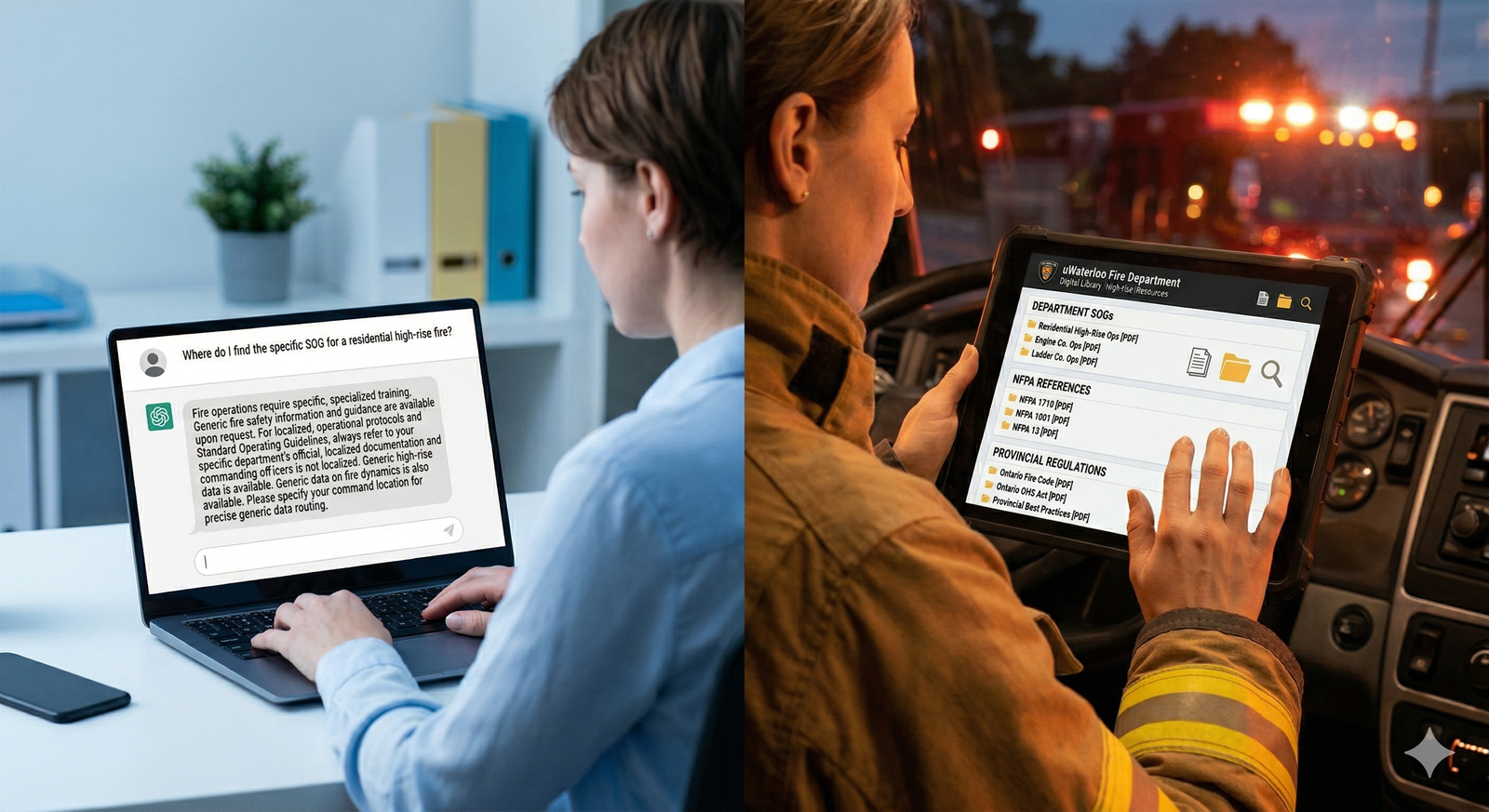
A district chief asks a generic AI chatbot: "What's the isolation distance for chlorine gas?" It generates an answer that sounds authoritative. Somewhere in that answer is a number that might be right, might be based on a standard that doesn't apply to your jurisdiction, or might be something the AI confidently invented. This is what "hallucination" means in AI: not confusion, but confident invention.
Now ask the same question of an AI system that has read your agency's SOGs, mutual aid agreements, provincial hazmat procedures, NFPA standards you subscribe to, and your local industrial facility profiles. The answer comes back grounded in what you actually do, what standards you follow, and what your community's specific hazmat profiles are. It cites its sources, so you can check any part of the answer against the document it came from instead of taking it on faith.
The difference between generic AI and agency-specific AI is the difference between a search engine and your own operating manual.
Why Existing Approaches Fall Short
Generic AI tools like ChatGPT or Gemini are trained on internet text. They can summarize, brainstorm, and draft. But they know nothing about your agency's actual policies, equipment, jurisdiction, or how you operate. When they need to cite a standard, they often get it wrong. When they need to reference your procedures, they can't. So they either refuse to answer or they guess, which is worse.
Consultants and external experts can give you accurate, standards-based advice, but they don't know your specific operational context. Your equipment. Your staffing. Your mutual aid agreements. Your community's specific vulnerabilities.
What you need is an intelligence system that knows both: the standards and best practices, and your specific agency documentation, equipment, and environment.
What It Looks Like in Practice
It's 2 a.m. during an active incident, and a duty officer needs to refresh on the protocol for a specific hazmat material. Instead of hunting through procedures or calling the hazmat specialist who's already deployed, they ask the AI emergency service knowledge base: "What do we do if we're dealing with a large chlorine release and we're downwind of the residential area?"
The system responds with information grounded in three layers: your agency's hazmat SOG (which defines your isolation distances and evacuation triggers), the provincial hazmat standard you follow, and the NFPA reference that standard is based on. It includes information about nearby hospitals that handle chlorine exposure, your mutual aid resources for evacuation support, and whether the wind direction in your jurisdiction's topography creates specific concerns.
Every answer shows its work. Each point is tied back to the document it came from: your SOG, the provincial standard you follow, the NFPA reference underneath it. You can open the source and read it yourself before you act on it. And where the system is working from a partial match, a superseded revision, or a gap in what it has been given, it tells you that rather than smoothing over it.
That is the point. No AI system is right every time, and one that hides its uncertainty is more dangerous on the fireground than one that shows it. What a commander needs is not a machine that claims to be infallible. It is a machine that is straight enough about its sources and its confidence that you can judge how far to lean on any given answer: trust it where it has earned trust, verify it where it has not, and keep the decision where it belongs, with the person in command.
Later that same week, a captain is designing a new training scenario. She asks: "Based on our staffing and equipment, what are the tactical options for a vehicle extrication on Highway 7?" The system pulls her agency's extrication SOG, knows what equipment is in which stations, knows the mutual aid agreements, and grounds the answer in the actual tactical decisions she'd face with her specific inventory.
A month later, during an accreditation self-assessment, the emergency manager asks: "Where are we not aligned with provincial standards?" The system compares the agency's SOGs against current provincial standards and flags discrepancies. She can see exactly where policy needs updating and why.
What This Means for Your Agency
For incident commanders and duty officers: you have access to standards-based decision support that knows your actual procedures, equipment, and resources. You're not guessing. You're not waiting for callbacks.
For training and planning: you can develop realistic scenarios grounded in what you actually have and how you actually operate.
For fire chiefs and emergency managers: you have a knowledge system that grows with your agency. As you update procedures and add equipment, the system stays current.
For accreditation and compliance: your entire operational knowledge is documented, searchable, and standards-aligned. Audits become faster and easier.
"The best decision support system is the one that knows both the standards and your reality. Generic AI knows one. Your agency intelligence system knows both."
See HazReady on your jurisdiction
Every agency has its own procedures, hazards, and mutual aid picture. The quickest way to tell whether this fits yours is to see it working against your own material rather than a generic demo. Book a walkthrough for your agency.