How to Run a Multi-Agency Emergency Exercise Without Hiring a Consultant
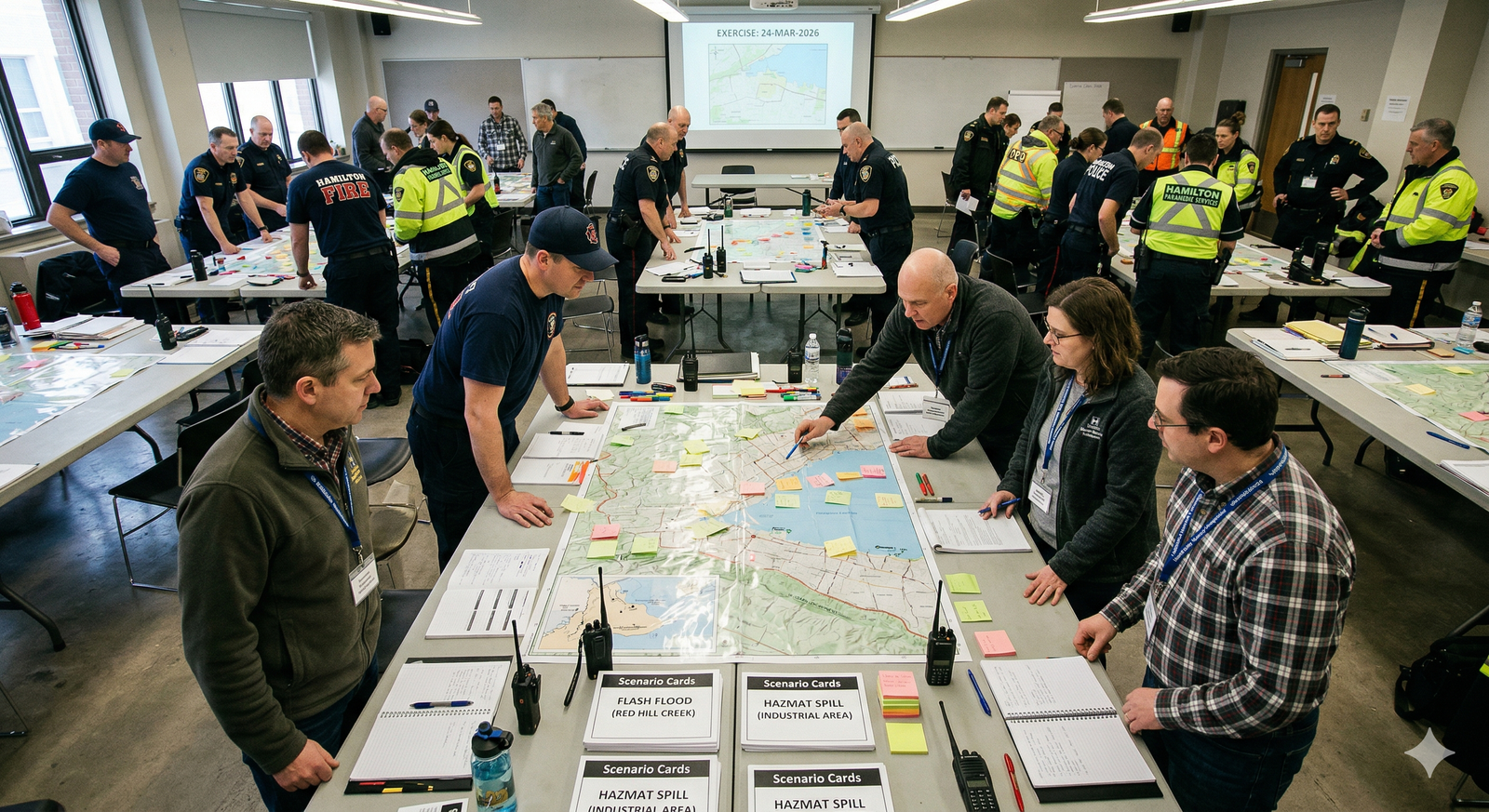
Emergency exercises are legally required across most of Canada. They're also essential. They're the only way to test your plan before a real incident, find gaps in communication, and practice coordination with agencies you've never worked alongside. But designing a tabletop exercise, functional exercise, or full-scale exercise requires specialized expertise most agencies don't have. The result: agencies either skip exercises altogether, run generic low-effort drills that teach nothing, or spend $10,000 to $50,000 or more hiring a consultant to design and facilitate one.
The problem isn't that exercises are complicated. It's that designing good ones requires knowing how to layer realistic injects, coordinate multiple agencies, build evaluation criteria, and document lessons learned. That's not a standard skill for most fire chiefs or emergency managers.
Why Existing Approaches Fall Short
Generic exercise designs don't account for your specific operational environment, your actual mutual aid agreements, or the specific gaps you're trying to identify. A consultant-designed exercise is tailored but expensive and happens once every few years, after which the design disappears and you start over.
Self-designed exercises often become either too narrow (just testing your own procedures) or vague (running an incident scenario with no real objectives). Coordinating multiple agencies across a single exercise requires clear role cards, synchronized timing, and evaluation rubrics that most agencies create ad hoc, if at all.
What It Looks Like in Practice
It's February, and a volunteer fire chief in a composite agency needs to run a tabletop exercise as part of his accreditation requirements. Normally, this would mean weeks of planning and probably an external facilitator. Instead, he logs into HazReady's Exercise Builder and answers a short set of questions: What type of exercise? Tabletop. What agencies are involved? Fire, EMS, police, hospital, dispatch. What scenario? He knows his biggest vulnerability: a multi-vehicle collision on the highway involving hazardous materials.
The system generates a complete exercise package: an incident scenario, inject sequences for the exercise controller, role-specific materials for each agency, evaluation criteria tied to his accreditation standard, and a post-exercise evaluation form. He schedules the exercise, briefs each agency on their role, and runs a two-hour session. Participants get specific, realistic injects at realistic intervals. Everyone knows what they're being evaluated on.
After the exercise, the evaluation data is captured in structured format. His after-action report identifies three specific gaps and three things they did well. He shares this with his exercise participants and begins addressing gaps in his next operational period.
He spent about six hours of personal time, zero dollars on consultants, and learned more about his multi-agency coordination than he would have from a generic exercise that he'd never designed or owned.
What This Means for Your Agency
For volunteer fire chiefs and small composite agencies: you get exercise expertise without consulting fees. You can run exercises more frequently because the barrier is no longer cost, it's just scheduling people's time.
For dedicated emergency managers: you have a design tool that lets you quickly develop exercises for specific learning objectives without outsourcing the work.
For multi-agency coordinators: you can generate exercises that clearly define each agency's role, decision points, and communication windows. Everyone knows what they're supposed to do and what they're being evaluated on.
For accreditation and compliance: you have documented exercises with evaluation criteria and post-exercise reports that demonstrate due diligence and continuous improvement.
"A good exercise isn't about finding disasters you didn't plan for. It's about finding the small coordination gaps that only show up when everyone is in the room at the same time."
See HazReady on your jurisdiction
Every agency has its own procedures, hazards, and mutual aid picture. The quickest way to tell whether this fits yours is to see it working against your own material rather than a generic demo. Book a walkthrough for your agency.