Wildfire Season Requires 25 Agencies to Coordinate. Here's How Small Communities Actually Do It.
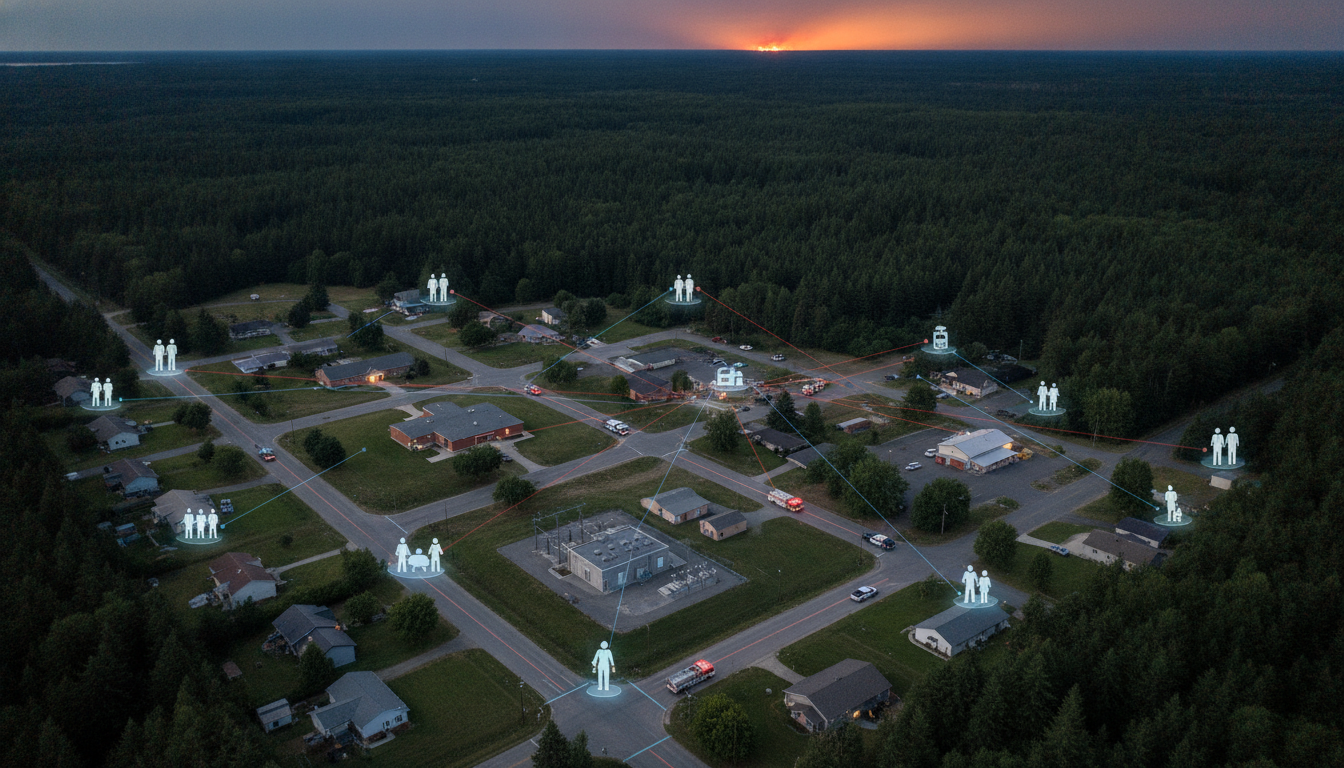
Wildfire preparedness in a WUI community is a multi-agency coordination problem, not a fire service problem. At least 25 different roles across fire, police, emergency management, health care, utilities, public works, schools, social services, and more each carry specific tasks across three phases: pre-season preparation, active response, and recovery. Without a shared coordination tool, responsibility stays implicit, communication stays ad hoc, and readiness gets assumed rather than verified. When a real fire starts, you find out who was ready and who wasn't. By then, it's too late.
Environment Canada projects 2026 to be among the hottest years on record, with temperatures forecast 1.35 to 1.53 degrees Celsius above pre-industrial levels. After three consecutive active wildfire seasons, including the record 2023 burns that scorched over 14 million hectares across Canada, 2026 is shaping up as a genuine litmus test. BC has already begun mobilizing 2,400 seasonal firefighters and training over 1,700 fire agency personnel in wildland-urban interface operations. The urgency is real, and it's now.
Why Existing Approaches Fall Short
Spreadsheet-based preparedness plans document intentions. They don't create coordination. Email chains vanish into inboxes. Meetings happen, decisions get made, and three weeks later nobody outside that room can say with confidence what was actually decided or who owns what. When a new person steps into a role, there's no plan waiting for them. When a fire ignites, you're not working from a shared, current understanding of community readiness. You're improvising with people who may not know what they're supposed to do.
Larger communities sometimes have formal WUI coordination committees, but in smaller communities one person (often the fire chief, the emergency manager, or the CAO) ends up carrying the entire coordination burden in their head. When that person gets deployed or takes a job somewhere else, the coordination structure leaves with them.
It's also worth remembering that most of a community's critical resources sit outside the fire service. Schools have buses. Utilities have communication infrastructure. Health care has facilities and logistics capacity. Social services know the vulnerable populations. None of those agencies particularly want to own wildfire preparedness, but all of them are essential to it.
What Structured WUI Coordination Actually Looks Like
Picture a fire chief in a composite WUI agency: two stations, mountains on three sides, and responsibility for coordinating wildfire season preparation across more than 20 stakeholder groups. It's February. Instead of working the phones and managing a tangle of emails, she logs into HazReady's WUI Preparedness Portal and builds her community's preparedness plan from there.
She defines the roles: fire operations (evacuation zones, routes, resource positions), police (traffic management and evacuation support), EMS (route positioning and hospital coordination), schools (bus logistics and student reunification), utilities (power prioritization and communication network readiness), public works (route maintenance and debris management), health care (surge capacity and vulnerable population support), social services (vulnerable population registry and shelter coordination), and community members (evacuation readiness and fuel management on private property).
For each phase, pre-season, active season, and recovery, she defines specific tasks: create and maintain evacuation maps, verify mutual aid agreements, confirm hospital surge capacity, test the community alert system, verify the vulnerable population database. These aren't aspirational bullets in a binder. They're assigned, tracked, and visible to everyone who needs to see them.
She invites all stakeholder agencies into the portal. Each gets a role-based view showing their tasks, timelines, and how their work connects to everyone else's. The police captain sees her traffic control tasks and understands exactly how they tie to evacuation completion timelines. The hospital coordinator sees her surge capacity checklist. The school superintendent understands the bus coordination requirements and when they kick in.
Here's the part that matters most: everyone sees the overall plan. They understand how their piece fits into the whole. When someone completes a task, they mark it done in the portal. The community's overall preparedness status is visible in real time, to everyone, without anyone having to chase updates.
For communities with limited staff, the portal includes a role consolidation feature. The police chief without a dedicated emergency planning person can hold multiple roles without duplicating work. The fire chief covering both fire operations and evacuation coordination sees both task streams in one place, not two separate systems.
When active season arrives, the portal shifts to operational mode. When the fire is over, recovery tasks activate. And when a new fire chief shows up next year, the plan is still there. The role descriptions are still there. No institutional knowledge walks out the door.
What This Means for Each Group Involved
For fire chiefs in WUI communities, this is a coordination tool that lets you orchestrate across 20-plus agencies without holding everything in your head or in your inbox. You see the community's overall readiness at a glance, not pieced together from a dozen separate conversations.
For emergency managers, the platform organizes WUI preparedness into clear phases with explicit role accountability. Nothing falls through the cracks because there's no visible place for it to land.
For smaller communities with limited staff, role consolidation means one person can manage multiple aspects of preparedness without redundant meetings, duplicate documentation, or crossed wires.
For all participating agencies, there's clarity on specific tasks, dependencies, and timelines. Nobody is guessing at what they're responsible for or when it needs to happen.
For council and oversight bodies, there's a transparent, auditable preparedness structure. You can see what's ready and what isn't, before a fire starts, not after.
"Wildfire preparedness isn't about the fire service alone. It's about organizing an entire community to move together. That requires a tool that everyone can see and use."
See HazReady on your jurisdiction
Every agency has its own procedures, hazards, and mutual aid picture. The quickest way to tell whether this fits yours is to see it working against your own material rather than a generic demo. Book a walkthrough for your agency.